(Intuition Without Math Fear)
Goal of this chapter
- Build intuition for QUBO without heavy math
- Understand nodes and connections (graph view)
- See why QUBO works so well for complex problems
1. Why look at QUBO as a Graph?
So far, QUBO looked like a math formula:
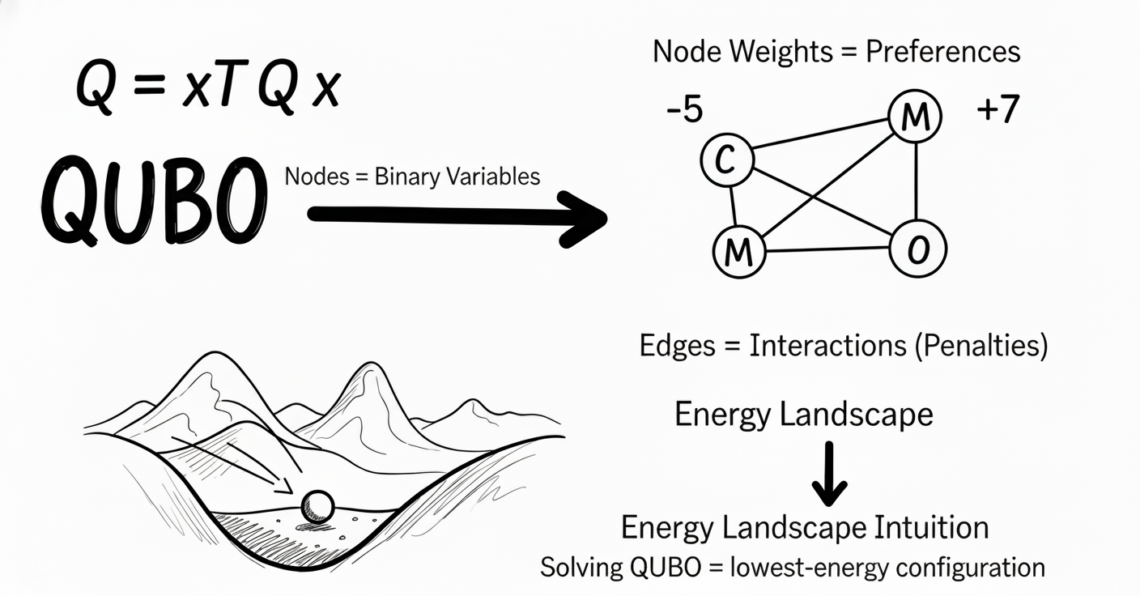
Q = xᵀ Q xBut behind the math, QUBO is really a graph problem.
Thinking in graphs helps you:
- visualize the problem
- understand interactions between choices
- debug bad QUBO models
2. Nodes = Binary Variables
Every binary variable becomes a node.
Example:
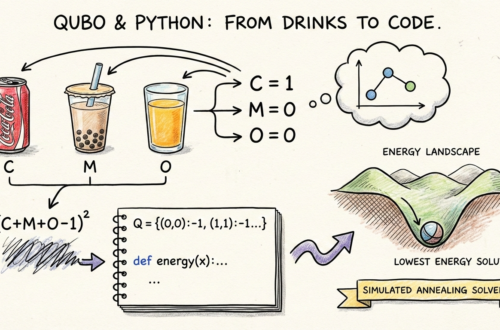
C = choose Coke
M = choose Milk Tea
O = choose Orange Juice
Graph view:
- Node C
- Node M
- Node O
Each node can be:
- OFF (0)
- ON (1)
3. Node Weights = Preferences
If a variable has a linear term, it becomes a node weight.
Example objective:
-5C + 7M + 0OGraph interpretation:
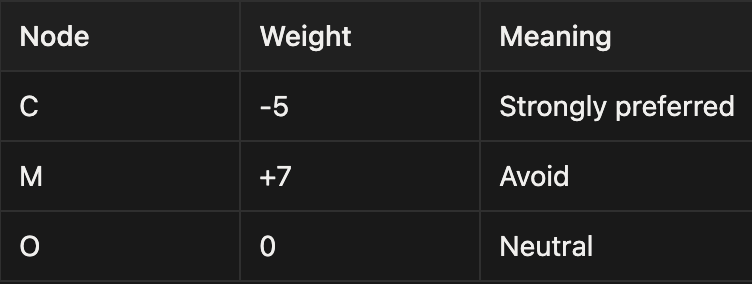
Turning ON a node adds its weight to the total cost.
4. Edges = Interactions (Penalties)
When two variables multiply each other, they form an edge.
Example penalty:
CMGraph meaning:
- If both C and M are ON, add penalty
- If one or both are OFF, no penalty
Edges enforce rules like:
- “Don’t pick both”
- “These two conflict”
5. Example: “Don’t Choose Both”
Rule:
- You cannot choose Coke and Milk Tea together
QUBO penalty:
CMGraph view :
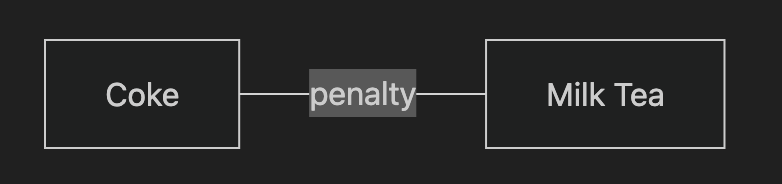
- Node C (Coke) and node M (Milk Tea) represent choices
- The edge means: if both are ON → penalty is added
If both nodes are ON → penalty is added.
6. Exactly-One Constraint as a Graph
Constraint:
(C + M + O - 1)²Expanded form:
C + M + O
+ 2(CM + CO + MO)
- 2(C + M + O)
+ 1
Graph view:
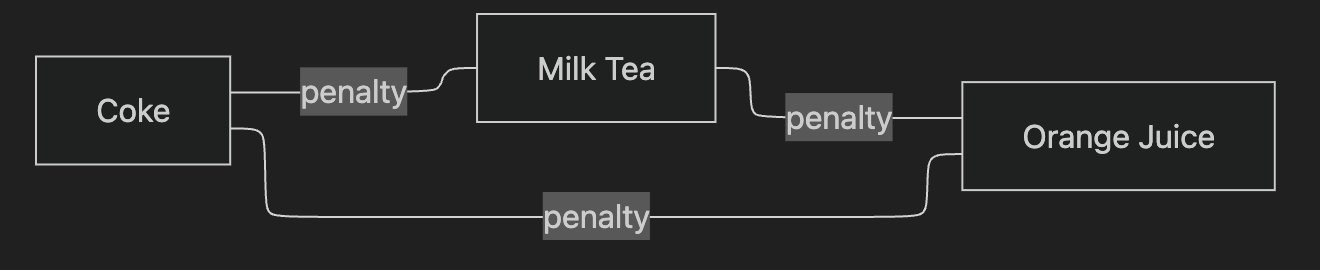
- Each node = one choice
- Every pair is connected
- Edges penalize choosing multiple items
This is why exactly-one constraints create fully connected graphs.
7. Energy Landscape Intuition
Think of QUBO as a landscape:
- High hills = bad solutions
- Deep valleys = good solutions
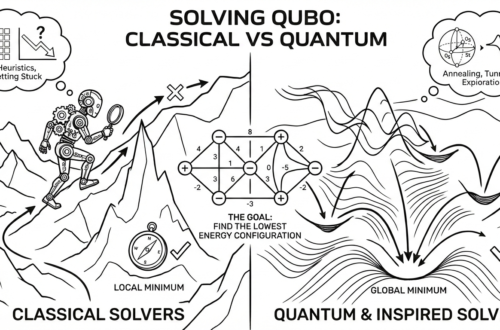
The solver is like a ball rolling downhill.
- Penalties create steep cliffs
- Preferences create slopes
The lowest valley = best solution.
8. Why Graph View Matters in Practice
Graph intuition helps you:
- reduce unnecessary connections
- tune penalty weights
- understand solver performance
Sparse graphs → easier to solve
Dense graphs → harder but expressive
9. Key Takeaways
- QUBO = graph + weights
- Nodes = choices
- Edges = interactions / penalties
- Solving QUBO = finding lowest-energy configuration
Keep in mind this
Nodes want to turn ON
Edges tell them who they can’t be ON with
If this makes sense, the next step inChapter 5: Solving QUBO will feel much more natural.